SBC Pylon — Engineering Specification
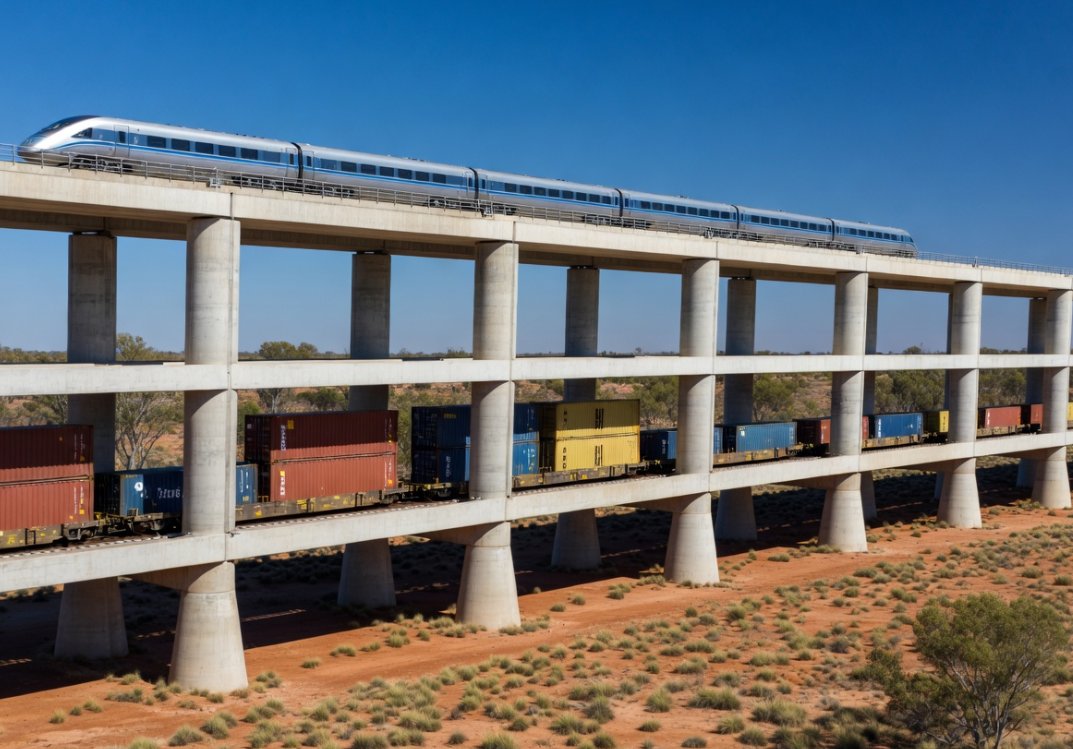
The SBC viaduct is built on a standardised modular pylon. Per Pylon Design Rev 3, two design variants serve all phases. Both use identical structural principles — stackable precast columns, cap beam at every level, standard crane construction, dry mechanical joints, no bespoke beam launcher. Construction is in two stages: Stage 1 builds the freight viaduct (revenue from Month 20), Stage 2 adds upper structure on the running freight line.
Design Hierarchy
Two levels built. Two expansion-ready above. The ask to government.
- Level 1 — Freight × 3 — 150–200km/h
- Level 2 — Maglev × 2 + service rail — 600 km/h
- External — HVDC 6 × 2 bipolar — 72GW
- Level 3+4 — expansion-ready stubs
Stage 1 freight operating. Service crane on running line installs Stage 2 upper structure. No new pylons.
- Stage 1 freight viaduct already operating
- Level 3 — services: gas / H₂ / fibre / water
- Level 4 — hyperloop-ready floor
- External — HVDC arms at Level 4
Big Bertha. All services. $6M/km at Mega Factory maturity.
- Level 1 — Freight × 3
- Level 2 — Water conduit 10,000GL/yr
- Level 3 — Services deck
- Level 4 — Hyperloop
- Level 5 — Maglev × 2 + service rail
- External — HVDC 72GW → 108GW
Design B Locked Dimensions (per Pylon Design Rev 3)
| Element | Dimension | Status |
|---|---|---|
| Outside width (leg OD to OD) | 17,000mm | LOCKED |
| Inside clear width | 14,500mm | LOCKED |
| Pylon span | 25,000mm | LOCKED |
| Total height to top of maglev train | 18,400mm | LOCKED |
| Leg base diameter | 2,500mm | LOCKED |
| Leg top diameter | 1,600mm | LOCKED |
| Leg height to HB1 soffit | 6,000mm | LOCKED |
| HB1 + HB2 freight deck depth | 1,700mm + 1,700mm | LOCKED |
| Freight deck top surface | 9,400mm agl | LOCKED |
| Freight clear height | 6,100mm | LOCKED |
| Connecting column diameter | 800mm | LOCKED |
| HB3 + HB4 maglev deck depth | 1,200mm + 1,200mm | LOCKED |
| Maglev deck top surface | 17,900mm agl | LOCKED |
| HVDC arm length each side | 4,000mm | LOCKED |
| Total width including HVDC | 25,000mm | LOCKED |
Three Lines on the Maglev Deck
Two maglev tracks and one central service rail. 2,300mm clear between vehicles. All three operate independently.
| Line | Position from left edge | Purpose |
|---|---|---|
| Maglev Track 1 | 3,500mm CL | 600 km/h passenger service |
| Service rail | 8,500mm CL — dead centre | Construction crane + maintenance. Independent operation. |
| Maglev Track 2 | 13,500mm CL | 600 km/h passenger service |
Component Weights Per Bay
| Component | Qty | Unit weight | Total |
|---|---|---|---|
| Footing pads | 2 | 45t | 90t |
| Tapered legs | 2 | 42t | 84t |
| HB1 freight transverse | 1 | 83t | 83t |
| HB2 freight deck segments | 10 | 104t | 1,040t |
| Connecting columns | 2 | 9t | 18t |
| HB3 maglev transverse | 1 | 49t | 49t |
| HB4 maglev deck segments | 10 | 73t | 734t |
| HVDC arms (steel) | 6 | 2.5t | 15t |
| Total per bay | 34 items | — | ~2,113t |
Heaviest single lift: 104t. Required crane: 150t rail-mounted standard. 40 bays per kilometre. 17,360 bays per ~430km Phase 0 segment.
Factory Cost Per Bay
| Component | Factory cost |
|---|---|
| 2 footing pads | $29,600 |
| 2 tapered legs | $33,800 |
| HB1 freight transverse | $94,500 |
| HB2 freight deck × 10 | $669,000 |
| 2 connecting columns | $5,944 |
| HB3 maglev transverse | $65,958 |
| HB4 maglev deck × 10 | $566,630 |
| HVDC arms × 6 | $58,932 |
| Total per bay | $1,524,364 |
40 bays/km × $1,524,364 = $61M/km factory cost. Total installed including site, track, systems and contingency: $235M/km current rates / $146M/km at volume (Phase 0 Stage 1 + Stage 2).