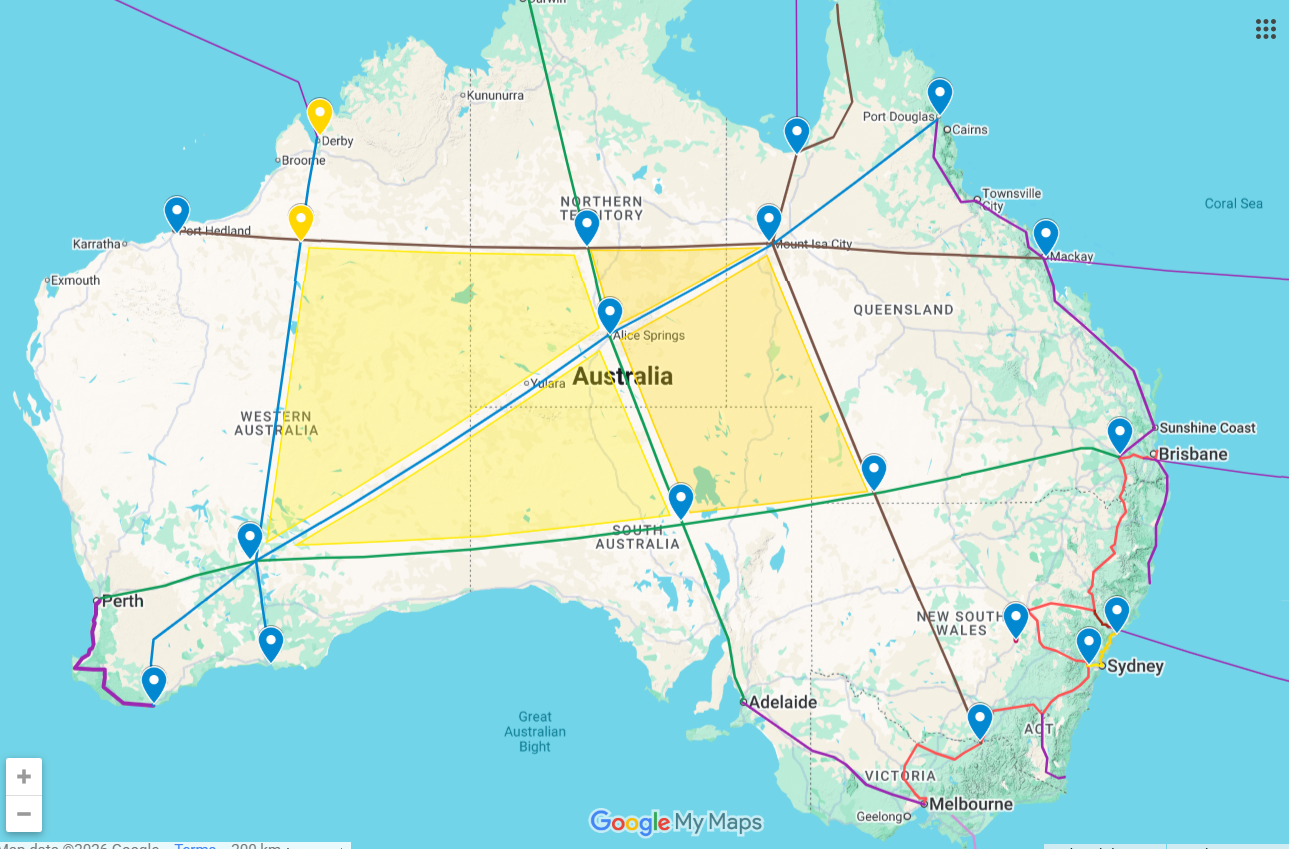
The Sovereign Build Corporation is a multimodal elevated viaduct — electrified freight, maglev passenger at 600 km/h, HVDC transmission, water, gas, hydrogen and sovereign fibre — built above existing Australian rail, road, and transmission corridors. Phase 0 runs Melbourne to Brisbane via Tullamarine, Bendigo, Albury, Wagga, Canberra, Western Sydney Airport, Muswellbrook, Tamworth, Armidale, Wellcamp and Brisbane — 2,290 kilometres. A 111 kilometre Phase 0.1 spur connects Newcastle into the Hunter Hub at Muswellbrook. The MMP ask is a change of direction: redirect the $93 billion currently committed to the HSRA tunnel into Phase 0 instead. Same year. Same money. Different country. Estimated completion: 2035 (full Phase 0). The complete Phase 0 programme delivers Melbourne to Brisbane before the HSRA delivers its first stage from Sydney to Newcastle in 2042.
Every kilometre of SBC viaduct carries seven services on a single structure: two maglev passenger tracks at 600 km/h, three electric freight tracks (replacing diesel road haul), HVDC transmission at 72 GW, water transmission, gas, hydrogen pipeline, and sovereign fibre. Every pylon footing is also a four-metre groundwater bore. This is fundamentally different from the HSRA, which delivers passenger transport only on a single corridor at single-service cost. One viaduct. Seven services. Multi-service economics. $235 million per kilometre at current Australian rates, falling to $148 million per kilometre at production volumes — less than half the per-kilometre cost of the HSRA passenger-only proposal, while delivering seven times the service capacity.
Phase 0 runs almost entirely on existing rail reserves, road corridors, and transmission easements. Where private farmland is touched, the footprint is leased from landholders, not compulsorily acquired — the elevated pylon design takes a 2.5m × 2.5m footing every 25 metres, leaving 97.5 percent of the easement strip free for ongoing agricultural use underneath. Zero national parks. Zero tunnels. Minimal farmland touched. The Inland Rail corridor and existing freight reserves do the work the HSRA proposes to do with 155 kilometres of new tunnel through nine national parks. Construction by stages: the freight line is commissioned at Month 20 of the programme. Freight revenue begins from Year 3, paying for the maglev superstructure built above it. The government invests in one thing — the freight line. Everything above it is commercially self-funded.
Australia holds a 23-day strategic fuel reserve against the IEA 90-day obligation. The SBC freight backbone removes diesel road dependency on every major export route. Continental water transfer of up to 30,000 gigalitres per year from northern wet-tropics catchments to the Murray-Darling basin via the Alice Hub pumped-hydro system — the SBC is the infrastructure that makes drought-proofing the agricultural heartland physically possible. HVDC transmission at 72 GW connects stranded renewable generation to load centres, replaces the failing Rewiring Australia AC plan, and exports surplus power via Darwin to Asia.
The architectural primitives that make the SBC buildable are protected by the Anchor Tension System (ATS) Patent Family — five Australian Provisional Patents filed at IP Australia between 24 and 29 April 2026 (AU 2026903869, AU 2026903952, AU 2026903992, AU 2026904069, AU 2026904075). Owned in Australia, by Australians, before construction begins. The Pylon Design itself is published as defensive prior art — the design is freely available for sovereign use, while the underlying architectural primitives are patent-protected for international licensing. The IP belongs to the country that builds the asset. See the patent record →
Phase 0 is the spine. Once Phase 0 is approved, built, and operational, the six transcontinental corridors follow in sequence, each new corridor funded from the operating revenue of the one before. SBC#1 Brisbane to Perth via Kalgoorlie. SBC#2 Darwin to Port Adelaide via Alice Springs. SBC#3 Albury to Karumba via Mount Isa. SBC#4 Mackay to Port Hedland via Mount Isa. SBC#5 Broome to Esperance via Kalgoorlie. SBC#6 Mount Isa to Perth via Alice Springs. Total network approximately 22,400 kilometres. Eleven new inland intersection cities. Every state with interior gets a major new node. Every capital-city airport on the network. Every major commercial port connected. The continental network completes itself — revenue from each corridor builds the next.
Same endpoints. Same population. Same problem the country is trying to solve. Two completely different answers. The figures below for the HSRA are sourced from the Prime Minister’s Capital Brief opinion piece (4 March 2026), Infrastructure Australia’s Stage 3 Evaluation Report (November 2025), and the High Speed Rail Authority’s own published business case material.
| Dimension | SBC Phase 0 | HSRA |
|---|---|---|
| Route | Melbourne to Brisbane — 2,290 km inland spine. Plus 111 km Newcastle–Muswellbrook spur (Phase 0.1). | Sydney to Newcastle only — 194 km. Stage 1 of an east-coast vision that may or may not be built across 30+ years. |
| Services on the corridor | 7 services on Day 1 — electric freight, maglev passenger, HVDC, water, gas, hydrogen, fibre. Expandable to 9+. | 1 service — passenger rail only. |
| Speed | 600 km/h continuous maglev across the full 2,290 km. No tunnel speed restrictions. | 320 km/h peak — but only on roughly 80 km Gosford–Newcastle. Sub-200 km/h south of the Coast in tunnels. |
| Tunnels | Zero tunnels. Built on existing rail reserve and elevated viaduct. | PM Albanese: 50–60% of route in tunnels (Capital Brief, 4 March 2026). IA Stage 3: 155 km of 194 km (~80%). |
| Cost per kilometre | ~$235M/km current rates, falling to ~$148M/km at production volumes — for 7 services. | ~$474M/km — for 1 service. Subject to upward revision as design maturity rises from current 10–15% (IA Stage 3 finding). |
| Where the money goes | ~65–75% Australian content. Australian rail mill (Hunter region), Hunter Valley precast mega-factory, Australian seamless tubular mill, Australian concrete and structural steel. Builds sovereign manufacturing capability. | ~35–45% Australian content. 8–12 tunnel boring machines imported from Germany or China at $30–50M each — $300–500M offshore on TBMs alone. Rolling stock imported from France, Germany, or Japan. Rail steel imported (no Australian rail mill). Signalling proprietary European or Japanese. |
| First revenue / first service | Year 3 — freight line commissioned at Month 20. Freight revenue funds the maglev superstructure built above it. Full Phase 0 completion estimated 2035. | Year 12 (2037) — Newcastle to Central Coast. Sydney Central 2039. Western Sydney International 2042. |
| Full Melbourne – Brisbane delivery | By 2035 — Phase 0 spine complete. The full continental network (six transcontinental corridors) follows after Phase 0, funded from operating revenue. | 2060 (HSRA “vision”) — HSRA chair Jill Rossouw, February 2026. Infrastructure Australia’s Stage 3 evaluation: even 2060 is unlikely unless multiple stages run concurrently. The SBC delivers it 25 years sooner. |
| Benefit-cost ratio | Self-funding from Year 3. The freight line is the essential infrastructure, the maglev is what the freight line pays for, the cities are what the network delivers. | BCR 0.2 (4% discount) / 0.1 (7% discount) — Infrastructure Australia Stage 3 Evaluation, November 2025. Every dollar spent returns 20 cents. |
| Cumulative revenue at 2037 | ~$20–40 billion already earned by the time the HSRA opens its first station. Freight tolls and HVDC transmission revenue running for ~7 years before HSRA Stage 1A revenue starts. | $0 prior to 2037. Eleven years of construction spending with zero return. First fare revenue: Newcastle–Central Coast, $31 ticket, 2037. |
| Stations served | All 33 CCN stations retained on upgraded passenger-only Central Coast Line. Plus new SBC stops at Muswellbrook, Singleton, Mudgee, Maitland, Cessnock, Tamworth, Armidale, Wellcamp. Every Hunter and inland community connected. | 1 station in Robertson (Gosford), 0 in Hunter inland. Stage 1: Broadmeadow, Lake Macquarie (Morisset), Gosford, Sydney Central, Parramatta, Western Sydney Airport — 6 stations total. Existing CCN stations bypassed entirely. |
| Hunter & inland passenger | Muswellbrook 30 min to Newcastle. Mudgee 2.5 hr to Sydney. Singleton ADF base 2 hr to Central. Maitland direct to WSA. ~200,000 Upper Hunter and inland residents get viable rail for the first time. Reverses Upper Hunter depopulation trend. | Zero. Not modelled. Not in scope. Not considered. The HSRA demand model contains no trips from Muswellbrook, Mudgee, Singleton, Cessnock, or Maitland. Northern terminus at Broadmeadow, Newcastle — 4 km from CBD on a contaminated industrial site. |
| Coastal freight removal | All freight migrates inland voluntarily. 1,200 km of coastal corridor freed — Taree, Kempsey, Coffs Harbour, Grafton, Lismore. Sleep restored, vibration eliminated, level-crossing horns gone. Driven by economics: SBC freight 45% cheaper than coastal diesel rail. | Zero freight removed. HSRA is passenger-only. Freight stays on the Central Coast Line and the North Coast Line. The single biggest amenity issue facing 1,200 km of coastal communities is unaddressed. |
| Net emissions impact | Operational ~7 g CO2e per tonne-km (electrified freight, ~95% lower than truck). Zero embodied tunnel emissions. National freight decarbonisation without legislation or carbon pricing. | +3.6 Mt CO2e net increase across HSRA Stage 1 lifecycle — tunnel construction embodied carbon exceeds operational savings. The "100% renewable" branding does not offset 155 km of concrete tunnel. |
| Land acquisition | No compulsory acquisition. Existing rail, road, and transmission corridors. Where farmland is touched, footings are leased from landholders — 2.5m × 2.5m every 25m, 97.5% of strip remains farmable. | Nine national parks, four nature reserves, two regional parks, one State Conservation Area, one State Forest traversed. $104M biodiversity offset allowance. |
| Workforce risk | Sovereign manufacturing base. Five-day modular pylon assembly cycle. Trades-friendly construction methodology. | IA Stage 3 finding: 35% workforce shortage in NSW heavy and civil engineering construction across 2029–2036 peak construction years. Project crowds out other infrastructure. |
| IP and ownership | ATS Patent Family — 5 Australian Provisional Patents filed. 95% Australian content. Sovereign manufacturing of rail steel, seamless tubular, precast concrete, structural steel. | Imported high-speed rail systems. No sovereign IP. Mostly imported engineering and specialist labour. |
| Strategic-national value | Fuel sovereignty backbone: electrified freight on every major export and import route. Defence logistics. Continental water transfer to Murray-Darling. National HVDC backbone. | Commuter line: connects Sydney CBD to Newcastle CBD. Marketed as a housing policy. |
The SBC is delivered in four phases. Phase 0 is the Melbourne–Brisbane spine. The transcontinental corridors that complete the national network follow. Each phase has its own engineering, costing, and rollout schedule.
The SBC works because the engineering, the economics, and the IP are all on the public record. Five canonical documents tell the complete story: the Consortium Prospectus, the Master Development Document, the Multimodal Pylon engineering specification, the Australian Electricity Cost analysis, and the ATS Patent Family record. All five are open. Read them, share them, take them to your engineer, your MP, your union, or your local journalist. No secrets.