THE PROBLEM
WHAT THE GOVERNMENT IS ACTUALLY DOING
The HSRA Sydney-Newcastle proposal: 194km of coastal rail, 115km of it underground, through nine national parks, at a cost Infrastructure Australia says it cannot assess. Already $659 million committed and not one metre of track built.
| Item |
HSRA — Government Plan |
SBC Phase 0 — MMP Alternative |
| Route | 194km coastal — 59% underground tunnel | 1,940km total (465km new-build WSA–Newcastle) — 0% tunnel — beside existing freight rail |
| Tunnelling | 115km continuous — Hawkesbury, Hornsby Plateau, 9 national parks | Zero. Elevated pylon on flat Hunter Valley terrain. |
| Services delivered | 1 — passengers only. No freight. No energy. No water. | 11 — freight, maglev, HVDC, gas, H2, fibre, water, hyperloop slot |
| Cost | $93B stated (10–15% design maturity — IA warning) | $566B current rates / $352B at volume (Phase 0 only — 12+ services on one viaduct) |
| Cost per service | $93B per service | $8B per service at volume |
| Opens | 2042 — if no blowout (HS2 ran 3×, Snowy ran 10×) | Planning now — build 2027+ — operational before HSRA 2042 |
| Revenue before done | Zero until 2042 — 16 years of interest accumulation | $4–6B/yr HVDC from Month 24 |
| BCR status | "Not possible to make a confident assessment" — Infrastructure Australia | Positive from Day 1 — multiple contracted revenue streams |
| National parks impacted | 9 national parks traversed underground | Zero — follows 168-year old freight corridor |
| Freight electrification | None — HSRA never mentions freight | 3 electrified freight tracks — first in Australian history |
| Robertson benefit | Zero — doesn't come within 500km of Robertson | SBC#1 runs through Robertson. Water, rail, jobs, new towns. |
THE PATTERN
SNOWY 2.0 — WE'VE SEEN THIS BEFORE
Australia has already run this experiment. Tunnelling project, announced at low design maturity, BCR dependent on optimistic assumptions, independent warnings ignored. The result: $2B became $20B+.
The HSRA and Snowy 2.0 share the same origin story: a political announcement before any engineering assessment, a cost figure presented with false confidence, and independent warnings that were noted and set aside. The difference is that with the HSRA, Australia still has a choice. The TBMs are not yet in the ground. The window has not yet closed.
$2B
Snowy 2.0 announced — 2017
Announced by a Prime Minister who needed an energy policy. No rigorous engineering assessment. Design at <5% maturity. Same tunnel-heavy pattern.
$12B
First major reset — 2023
TBM Florence stuck in soft ground. Minister Bowen: "should not have come as a surprise." It came as a surprise because the ground investigation was not done.
$20B+
Current estimate — 2026
Every estimate wrong. Substantially and repeatedly. 67% complete. Completion unlikely before 2029–30. The geology was not unknown — it was unexamined.
27
HSRA boreholes — 194km route
One borehole every 7.2km through the most geologically variable terrain in Australia. For 115km of continuous tunnel, this is wholly inadequate. Infrastructure Australia said so.
0.2
BCR at upper cost scenario
Infrastructure Australia's own evaluation: BCR collapses to 0.2 under upper cost / lower benefit scenario. Australia is being asked to approve a $93B project with a BCR that may be 0.2.
2028
The point of no return
By 2028 — corridor gazetted, environmental approvals locked, contractors signed, $659M spent. Sunk cost logic makes it unstoppable. The window to choose the alternative is now.
THE EVIDENCE
WHAT HAPPENS WHEN GOVERNMENTS BUILD TUNNELS
This is not a theory. These are the actual numbers from the last three major tunnel-heavy infrastructure projects Australia and the UK have attempted. The pattern is not a coincidence — it is a structural feature of how tunnelling projects work.
🇦🇺 SNOWY 2.0 — AUSTRALIA
Announced 2017 · Still not complete
| Announced cost | $2B |
| First reset (2023) | $12B |
| Current estimate (Oct 2025) | $20B+ |
| Blowout multiplier | 10× |
| Original opening | 2021 → 2028+ |
TBM Florence stuck in soft ground "that should not have come as a surprise." Design immaturity at Final Investment Decision. Cost now unachievable per October 2025 reassessment.
🇬🇧 HS2 — UNITED KINGDOM
Announced 2009 · Phase 1 only · Still not complete
COST BLOWOUT
| Announced 2009 | £37.5B (full line) |
| Phase 2 (Manchester) cancelled 2023 | £54–66B Phase 1 only |
| CEO formal estimate Mar 2025 | £81B (2019 prices) |
| In today's prices (inflation adjusted) | £100B+ (~A$200B) |
| Spent by Feb 2026 — ⅓ complete | £46.2B already gone |
| Blowout multiplier | 2.5–3× and rising |
TIME BLOWOUT
| Original opening (Phase 1) | 2026 |
| Revised target (2024) | 2029–2033 |
| CEO latest estimate (2025) | Late 2030s |
| Delay from announcement | ~30 years |
TUNNELLING PROBLEMS
| Ruislip, 2023 | Foam, mud & grout erupted on rugby pitch |
| Cause | Variable Lambeth Group geology — sand channels in clay |
| Chilterns tunnel, 2023–24 | Multiple sinkholes above tunnel |
| Chilterns final 140m | Unexpected clay after chalk — pipe blockages, delays |
| Euston tunnels | Deferred 2023 → 2025 → now 2026 launch |
| Euston approach tunnels | "Arguably much greater challenge" — hand-mined 1m at a time |
LAND ACQUISITION DISASTER
| Land budget Phase 1 (original) | £1.1B |
| Land cost actual Phase 1 | £5B+ (4.5× original estimate) |
| Spent on cancelled Phase 2 | £2.3B — route scrapped, money gone |
| Phase 2 agricultural land sale value | £26M — bought for £564M |
| Properties compulsorily acquired | 1,250+ farms & homes — many now sold at loss |
| Phase 1 surplus land | "Fire sale" underway to cut £100B bill |
CEO Mark Wild, March 2025: "construction started too soon, before stable and consented designs were available." 1,250 farms and homes compulsorily purchased along a route then partially cancelled. Agricultural land bought at premium — now worth a fraction. Farmers lost their properties with no right to buy back. The HSRA would do exactly the same — in Australia.
🇦🇺 HSRA — IF APPROVED
Announced 2023 · Decision 2028
| Stated cost | $93B |
| At Snowy 2.0 rate (10×) | $930B |
| At HS2 rate (2.5×) | ~$230B |
| BCR status | Cannot calculate |
| Design maturity | 10–15% per IA |
Infrastructure Australia: "not possible to make a confident assessment." 27 boreholes across 194km. Snowy 2.0 had the same design maturity at FID. We know how that ended.
The common factor across every blowout: tunnelling projects approved at low design maturity with optimistic cost assumptions and inadequate ground investigation. Snowy 2.0: soft ground "should not have come as a surprise." HS2: construction started before designs were stable. HSRA: 27 boreholes for 194km through the most geologically variable terrain in Australia. The MMP position is simple — modularity, surface construction, proven corridors. No tunnels. No BCR that cannot be calculated.
THE WITNESSES
WHO IS SAYING IT — AND WHAT THEY SAID
These are not MMP critics. These are Infrastructure Australia, independent transport experts, TBM lawyers, and financial analysts — all saying the same thing.
"Not possible to make a confident assessment of the proposal's benefit-cost ratio. Costs will vary considerably as design maturity improves."
Infrastructure Australia — Stage 3 Evaluation, Nov 2025
"Choosing Newcastle-Sydney first is a high-stakes gamble. Sydney-Newcastle was always going to be the most difficult and expensive part of the entire East Coast HSR."
Fastrack Australia — Analysis, Nov 2025
"Recent high-profile tunnelling disasters including Snowy 2.0 and M6 due to unforeseen ground conditions."
Colin Biggers & Paisley (TBM lawyers) — Law Society Journal, Mar 2026
"Australia is terrible at public infrastructure, paying too much for the wrong things. Apply Flyvbjerg 50%: expect $135B+."
IPA / The Australian — Feb 2026
"$93B plan risks colliding with Australia's worsening infrastructure cost blowouts. State net debt climbing to $900B by 2028–29."
Aussie Corporate — Financial Analysis, Mar 2026
"The predominant risk is cost and time blowouts. Lack of accurate information in the conceptualisation phase results in baseline cost overruns."
Applied Sciences Journal (peer reviewed) — May 2025
THE RISK
WHAT THE HSRA COULD ACTUALLY COST
Professor Bent Flyvbjerg (Oxford, 16,000 megaprojects): nine out of ten experience cost overruns. For tunnel-heavy projects, average overrun is 34%. Snowy 2.0 ran 10×.
$352B
SBC Phase 0 at volume (12+ services)
Even a 50% overrun — well below Snowy 2.0's actual 900% — produces a $140 billion single-service passenger tunnel for Sydney–Newcastle alone. The SBC Phase 0 delivers 12+ services for $352 billion at volume across the entire 2,410km Melbourne–Brisbane corridor. Per-service cost: SBC ~$30B vs HSRA $93B for 168km. The SBC delivers more value per dollar even at the most pessimistic cost assumptions.
THE ALTERNATIVE
27 REASONS PHASE 0 WINS — THE STRUCTURAL FACTS
Not preferences. Structural facts about cost, risk, timeline, capability, and national need. All 27 are in the full submission — here are the ones that matter most for Robertson.
1
Cheaper — and delivers more
$352B at volume for 12+ services across 2,410km vs $93B for 1 service across 168km. Per-km per-service: SBC ~$12M/km/service vs HSRA $554M/km/service. Opens 7 years earlier. Pays for itself from Month 20 — Stage 1 freight viaduct revenue funds Stage 2 upper structure on the running line.
2
Zero tunnelling — zero tunnel risk
HSRA: 115km of continuous tunnel through the most uncertain geology in NSW. SBC: zero. Elevated beside the 168-year Main North freight corridor. Geology proven by 168 years of heavy freight.
3
Electrifies freight — first in history
Not one kilometre of electrified freight is proposed, funded, or scheduled on the east coast. The SBC Phase 0 is the first and only electrified freight plan in Australian history. Three dedicated tracks. Double-stack capable.
4
HVDC revenue from Day 1
72GW HVDC generating $4–6B per year from the moment it's energised. No other infrastructure in Australian history generates revenue before it's complete. HSRA generates zero until 2042.
5
Serves inland communities
HSRA: six coastal suburban stations, all in Labor electorates. SBC: Maitland, Singleton, Muswellbrook, Tamworth, Armidale — the mining and agricultural communities that built regional Australia.
6
Lease not seizure — 1,250 paid landowners
2.5m × 2.5m footings every 25m. 97.5% of easement free. Each farm with 4km of corridor earns $160–320k/yr. HSRA acquires land once. SBC pays forever. 1,250 farmers who support the SBC, not oppose it.
The full 27 reasons — covering cost, tunnelling risk, freight electrification, diesel dependency, travel times, hyperloop slot, wildlife corridors, flood immunity, aesthetics, and what defines a nation — are in the Phase 0 Submission (88 pages) available below.
SBC Phase 0 Submission v4 — April 2026
THE BETTER ANSWER — FOR SYDNEY-NEWCASTLE TOO
YOU DON'T NEED A TUNNEL. REMOVE THE FREIGHT.
The Sydney-Newcastle CCN line takes nearly 3 hours. Not because of distance — 167km. Because passenger trains share track with heavy freight. Freight has priority. Passengers wait. The HSRA solution is a $93B tunnel. There is a cheaper, faster, better answer.
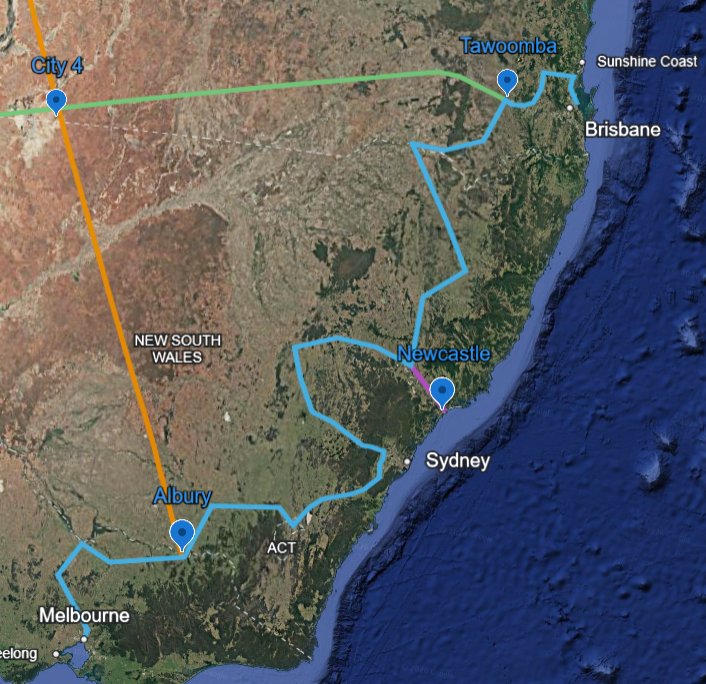
SBC Phase 0 (blue line) · 2,410.27km Melbourne → Brisbane inland · 0.8° max slope · zero tunnels · Google Maps locked 17 April 2026 · Phase 0.1 spur (magenta) Newcastle to Muswellbrook
2hrs 50min
SYDNEY → NEWCASTLE TODAY
The CCN intercity shares track with heavy freight. Freight priority means passenger trains sit in loops waiting. 167km taking nearly 3 hours is a political failure, not an engineering one. The solution doesn't require a tunnel.
~60–65min
CCN UPGRADE — NO TUNNEL NEEDED
Remove freight from the CCN. Send it inland on Phase 0's three dedicated electrified freight tracks. Upgrade the existing surface line to 200km/h. Electrify it. Sydney to Newcastle in 60–65 minutes. Opens ~2028. Cost: ~$3–5 billion.
15–20min
WHAT THE $93B TUNNEL BUYS EXTRA
The tunnel achieves ~45min vs 60–65min for the surface upgrade. That extra 15–20 minutes costs approximately $88–90 billion more and requires waiting until 2042. Australia is being asked to spend $93B to save 15 minutes over a surface upgrade.
| Option | HSRA — $93B Tunnel | CCN Upgrade + Phase 0 |
|---|
| Sydney → Newcastle | ~45min underground — opens 2042 | ~60–65min surface upgraded — opens ~2028 |
| Cost | $93B — BCR unquantifiable | ~$3–5B surface upgrade |
| Extra time saving | 15–20 minutes faster than the surface upgrade | 1hr 45min faster than today — from Day 1 |
| Cost per minute saved vs upgrade | ~$4.5–6B per minute of extra saving | Already delivered by the upgrade |
| Tunnelling | 115km — Hawkesbury, 9 national parks, unknown geology | Zero tunnels. Surface line upgrade only. |
| Freight outcome | Freight stays on CCN — congestion problem not solved | Freight moves to Phase 0 inland — CCN cleared |
| Country benefit | Zero | Phase 0 inland freight corridor runs through Robertson |
The CCN upgrade and Phase 0 are the same solution. Phase 0 takes freight off the coast and puts it inland on three dedicated electrified tracks through Robertson. With freight gone, the CCN surface upgrade to 200km/h is straightforward. Newcastle commuters get 60-minute travel by 2028. Robertson gets the inland freight corridor it was promised. And the $88 billion that isn't spent on the tunnel builds the infrastructure that serves the whole country.
THE ASK
THREE THINGS WE ARE ASKING FOR
This is not a request to stop the HSRA. It is a request for due diligence before $667 million locks the wrong route forever.
1
Independent comparative review
Commission a $20–30M independent engineering and economic comparison of HSRA tunnel design vs SBC elevated alternative. Before the 2028 FID. Both assessed by Infrastructure Australia using identical methodology. The result determines which design gets funded.
2
Phase 0 parallel design program
$30–50M to design the Brisbane–Newcastle–Sydney–Canberra–Melbourne corridor to 20% maturity in parallel with any HSRA development. Establish technology transfer partnerships with maglev and elevated viaduct manufacturers. Zero additional cost — same work the national SBC needs anyway.
3
Your vote — 2027 federal election
The MMP is the only party with a plan that serves Robertson. Vote 1 Brett Murrell. Put the MMP in a position to demand the independent review, push for the inland alternative, and ensure Robertson gets the infrastructure it was promised and never received.
The Snowy was not built because the economics were proven in advance. It was built because the engineers who designed it, the politicians who authorised it, and the workers who built it understood something that spreadsheets cannot capture: great infrastructure creates the conditions for prosperity that did not previously exist. Nobody in 1949 could model the full value of what the Snowy would become. The window to stop the tunnel closes in 2028. The inland alternative is ready.
— SBC Prospectus v62 · Brett Murrell, Moral Majority Party