Melbourne to Brisbane — Complete 2035
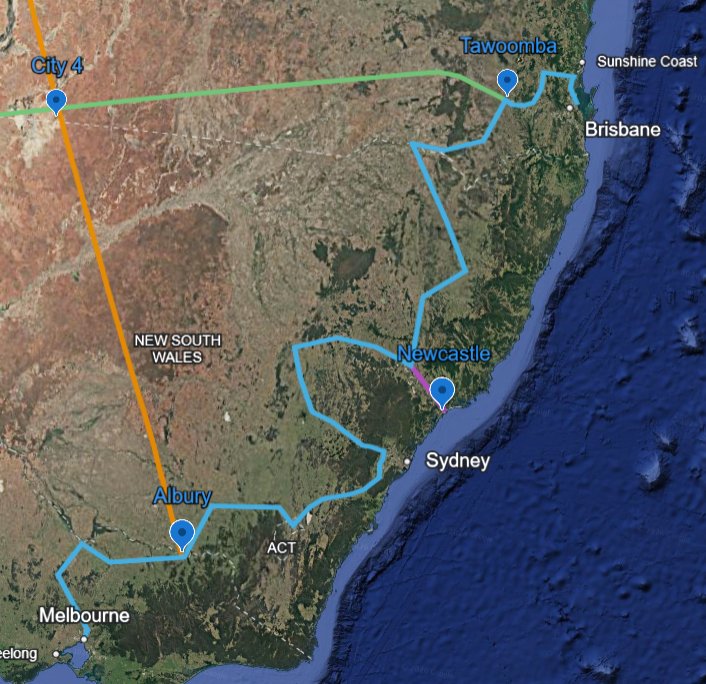
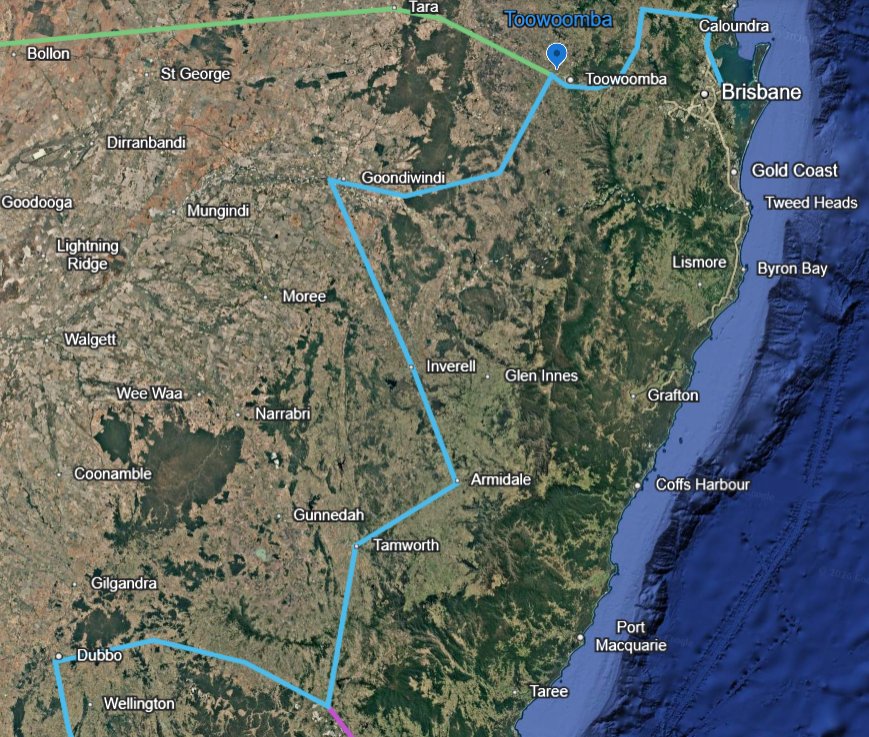
2,410.27km inland corridor from Melbourne through Albury, Canberra, Western Sydney Airport, Dubbo, Muswellbrook (Phase 0.1 spur junction), Armidale, Goondiwindi, the Toowoomba Wellcamp continental eastern hub and Caboolture to Brisbane. Twelve services simultaneously on a single multimodal viaduct from Day 1. Max slope 0.8°. Zero tunnels. Complete 2035 — seven years before the HSRA finishes Sydney to Newcastle.
Route Map
Northern half — town-by-town spine detail
The Case
The HSRA costs $474M per km and delivers one service — passengers — with revenue starting in 2037. The SBC Phase 0 costs $235M per km at current rates ($146M/km at volume — Wright's Law -38%) and delivers twelve services on one multimodal viaduct with revenue from Month 20. Built above existing rail corridors. Zero tunnels. Minimal land impact — route follows existing easements.
| Metric | HSRA | SBC Phase 0 |
|---|---|---|
| Cost per km — current rates | $474M/km | $235M/km |
| Cost per km — volume (Wright's Law) | — | $146M/km |
| Services | 1 — passengers only | 12+ simultaneously on one viaduct |
| Revenue from | 2037 | Month 20 |
| Melbourne–Brisbane | 2060+ unfunded | 2035 |
| Tunnels | 115km | Zero |
| Freight removed | Zero | 100% |
| National parks | 9 + 4 reserves | Zero |
| BCR | 0.2 — IA confirmed | Revenue-positive throughout |
Services
- 3 × electrified freight tracks — 150–200km/h — double-stack hi-cube under 6.5m catenary
- 2 × maglev passenger lines — 600 km/h — Melbourne to Brisbane in approximately 5 hours including stops
- HVDC transmission — 72GW standard / 108GW upgraded — ±1,100kV — connects desert solar to every capital
- Hyperloop slot — 6m clear structural reserve — technology-agnostic future provision
- Gas pipeline — 750mm X80 high-pressure
- Hydrogen pipeline — inland solar production to coastal export terminals
- Sovereign fibre — 96 ducts — leased to telcos for passive revenue
- Water — 1m community pipe (Design B) · ~75 GL/yr to corridor nodes
- Service rail — maintenance access along the corridor — independent of freight + maglev
The Inland Freight Philosophy
The SBC follows the inland route — Newell and New England Highway corridors — Australia's busiest freight roads. The 1.85× crow-flies ratio (2,410km rail vs 1,300km direct Melbourne–Brisbane) is the deliberate design choice that connects three capital cities, every farming community on the inland corridor, the Wellcamp continental hub, and removes freight from the coastal rail network. A direct 1,300 km line would serve only two cities and zero freight communities. Inland is how we do it. Coastal cities are served by parallel-phase spurs (Eden, Northern, Brisbane Southern, Melbourne–Adelaide).
- Removes all freight from the Sydney–Brisbane coastal corridor permanently from Month 20
- Coastal communities get faster passenger services as a free byproduct — no dollar spent on the coastal line
- $22/tonne freight saving across 50 million tonnes = $1.1B per year to freight operators
- B-doubles removed from the Newell Highway — inland towns get their main streets back
- Net zero freight movement from Day 1 of electrification powered by SBC HVDC
- New agricultural land unlocked — areas previously uneconomic become viable with cheap freight access
Toowoomba Wellcamp — The Continental Eastern Hub
SBC Phase 0 passes through Toowoomba Wellcamp Airport — Australia's first privately funded international airport, built privately on 800 hectares of flat land 130km west of Brisbane. Wellcamp is the QUADRUPLE JUNCTION of the eastern half of the SBC network — Phase 0 (Melbourne ↔ Brisbane), SBC#1 (Brisbane ↔ Perth, Phase 1), Northern Spur (Wellcamp ↔ Cape Tribulation, Phase 0-2), and Brisbane Southern Link (Wellcamp ↔ Port Macquarie, Phase 0-3). The single most strategically significant infrastructure parcel in Australia.
| Attribute | WSA Sydney | Wellcamp Toowoomba |
|---|---|---|
| Distance from CBD | 50km west | 130km west |
| Status | Opening 2026 | Operational since 2014 |
| Land holding | 1,780 hectares | 800 hectares — privately owned |
| Defence manufacturing | Planned | Sovereign autonomous combat aircraft — operational |
| SBC connection | Phase 0.1 southern terminus | Phase 0 northern hub — 37min to Brisbane |
| Funding | $5.7B federal government | Private investment |
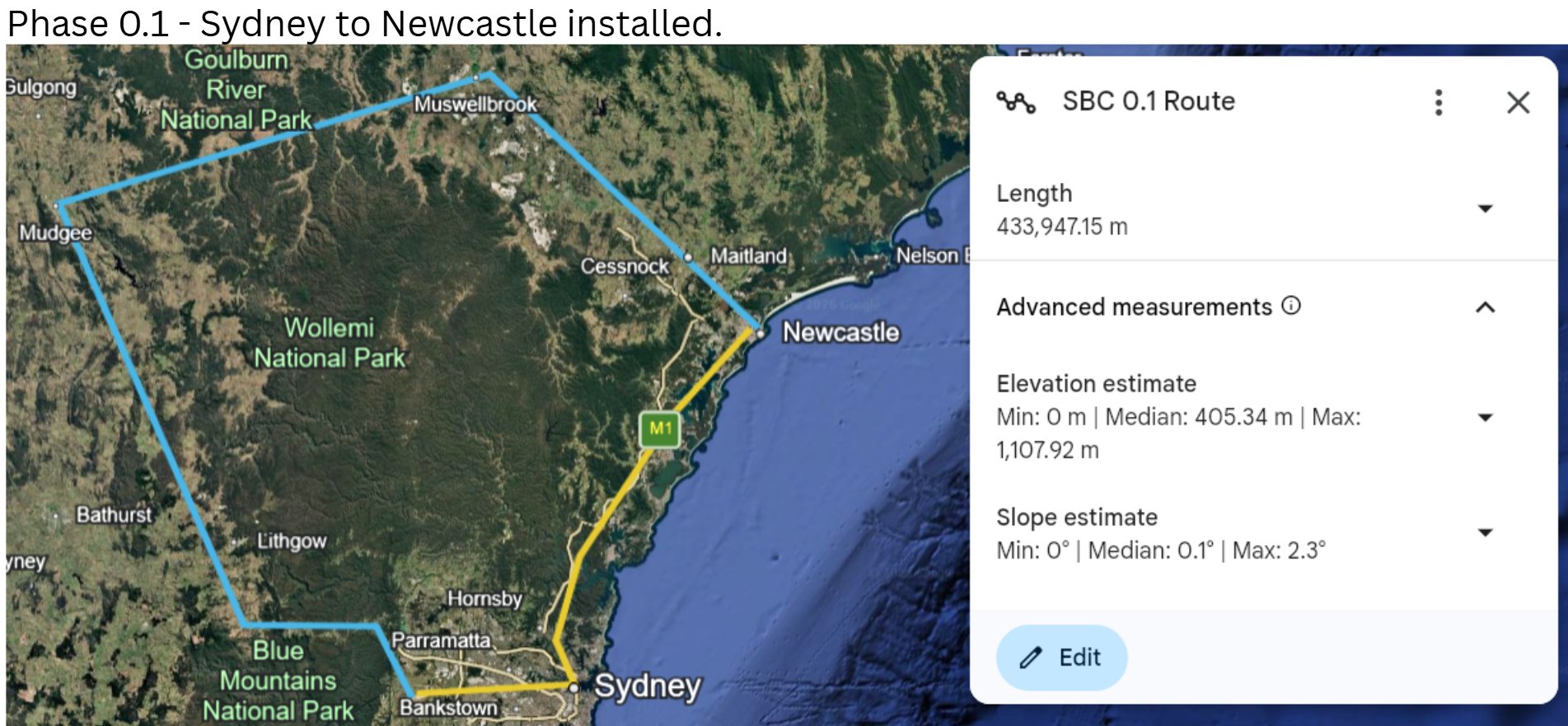
Phase 0.1 — Newcastle to Muswellbrook Spur
The Phase 0.1 spur connects Newcastle and the Hunter Valley to the Phase 0 mainline at Muswellbrook. 111.14km following the existing Hunter rail corridor — proven engineering, operating today. The 15.1° max slope is the existing line's reality, not a new engineering problem.
- Length: 111.14 km · Newcastle → Maitland → Muswellbrook
- Pylon: Design B (37.5m, 1m water pipe)
- Slope: 15.1° max — existing rail corridor reality, proven engineering
- Brings: Newcastle port + Hunter Valley industry onto the national network at Muswellbrook
- Removes: coal and grain freight from coastal rail
- Revenue: from Month 20 (Stage 1 freight viaduct first)
Construction Method
Same component repeated 17,000 times. Mega Factory built. Rail delivered. Crane installed. 20 simultaneous construction fronts.
- Stage 1 — freight viaduct constructed end-to-end as a 24-hour production line. Standard precast cap beam (HB1) + Super-T longitudinal girders (HB2) + factory-cast deck panels with Pandrol rail fixings. Maximum lift 80t — standard crane on viaduct. No bespoke beam launcher.
- Stage 1 commissioned at Month 20 — freight revenue begins. Cost ~$119M/km current rates / ~$74M/km at volume.
- Stage 2 — upper structure (P3/P4 columns, HB3/HB4/HB5/HB6 beams, HVDC arms, services deck, maglev guideway) installed by crane on the running freight line, working backward. Freight runs throughout.
- Stage 2 cost ~$116M/km current rates / ~$72M/km at volume.
- Phase 0 total ~$235M/km current rates / ~$146M/km at volume. Long-term Mega Factory target ~$25M/km → ~$6M/km.
- Commission and open everything simultaneously — 2035.
Timeline vs HSRA
| Year | HSRA | SBC Phase 0 |
|---|---|---|
| 2026 | Development phase. $659M planning. | Consortium forming. IA submission. |
| 2027 | FID. Still planning. | Construction begins both ends. |
| 2029 | Tunnelling. $8–12B spent. Zero revenue. | First freight revenue. |
| 2035 | Still tunnelling. ~$70B spent. Zero revenue. | Melbourne–Brisbane complete. All services live. |
| 2037 | Stage 1A opens. Newcastle to Gosford only. | SBC earning $5–8B/yr. Phase 1 building. |
| 2042 | Stage 1 complete. $93B. BCR 0.2. No Melbourne. No Brisbane. | National network substantially complete. |